
The First Self-Interpreting Technology
Heidegger and AI

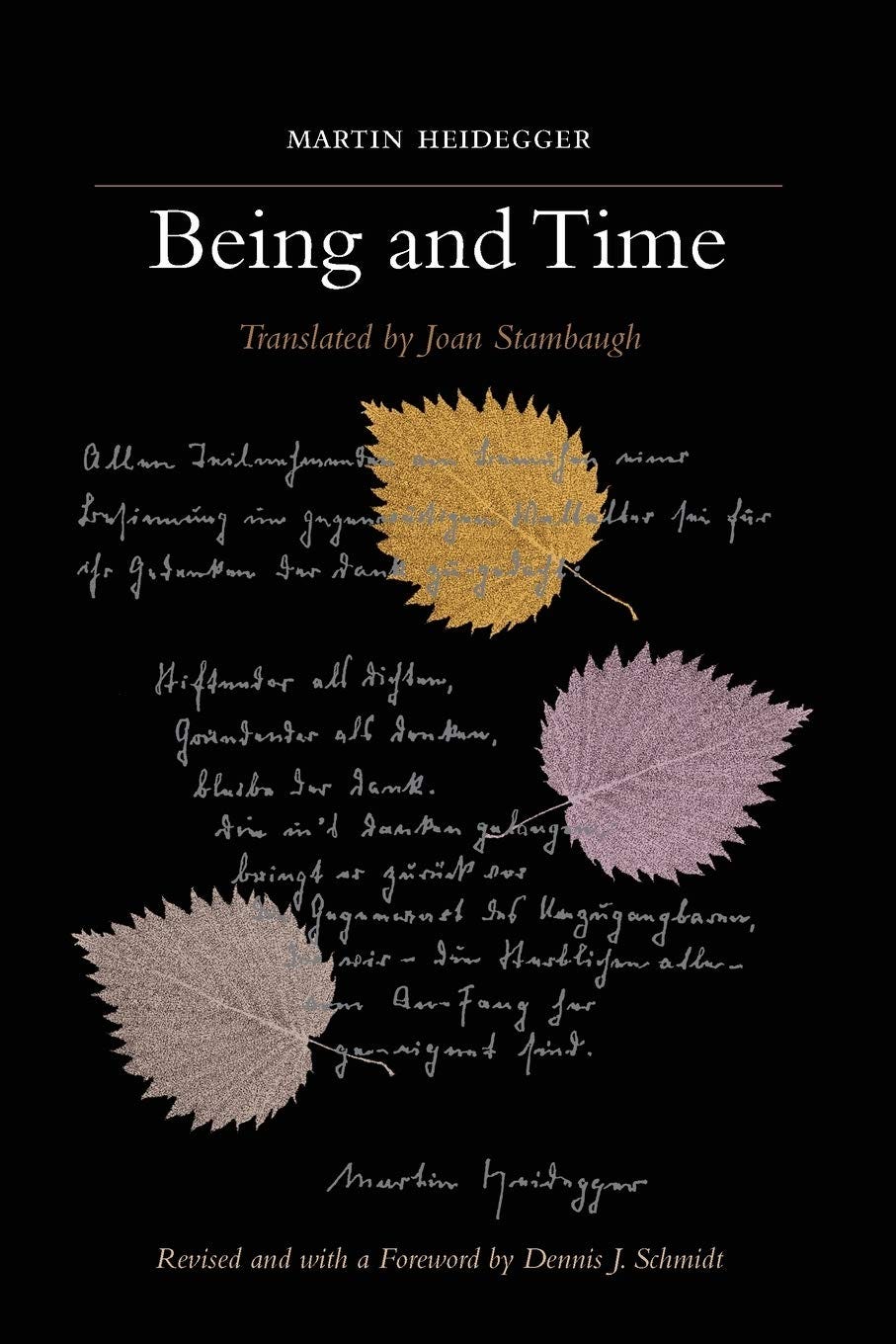
Heidegger argues in Being and Time that the human being is fundamentally implicated in interpretation. We are an existence that interprets the world and itself (as being-in-the-world). It is not just that we happen to interpret. To be (human) is to interpret. If we were not interpreting beings, not “hermeneutic,” we could not be concerned with the meaning of being, and yet we are, and that concern is of decisive interest for self-disclosure.
The world is always there for us with some pre-interpretation that provides the basis for deeper understanding. Philosophy as phenomenology is Heidegger’s way of bringing that basic fact about ourselves to light, not for the sake of an existential anthropology, but for the sake of fundamental ontology. His aim is to pursue the meaning of being. In doing so, he must show something about the being of meaning, hence the hermeneutic or interpreting nature of the human being.
The important point is that, for Heidegger, to interpret is a distinctly human affair. Non-human beings in our world that can be used as instruments, implements, utensils, tools…they do not exist as interpreting beings. To my left and my right are two cups, one of coffee, the other of water. The cups are “innerworldy beings”; they show up or occur for me in my living space, in my environment. For naive, ordinary understanding, they are things that are just there in front of me, to be used. And so they are. How they are for me is as useful items (a cup of cold water to cool me down and refresh me, a cup of hot coffee to perk me up and comfort me) . They do not interpret themselves or anything else. But they certainly do fall under the wide net of my acts of interpretation. Since interpretation covers “the world” and they are “innerworldly beings,” they bask in the light of the ever-ongoing “meaning-bestowal” that essentially characterizes human being.
If it helps you to understand what I have just said, imagine those video games where you are a character who gradually discovers a world represented on a map. Most of the map is black or grey or otherwise undifferentiated, but there is an illuminated bubble or circle around you, and as you move through the world, your illuminated bubble illuminates parts of the map. (Hopefully this conveys the basic image).
Imagine that you yourself are such a bubble, and that the world around you is what shows up for you in the illuminated space that you bring with you wherever you go. It shines by virtue of your light, the specific warmth and intensity of which provides the colour, the mood, the ambience of whatever you elucidate. It is not that there is a world “out there” that you, a self-enclosed atomic individual “in here” encounter “objectively.” For Heidegger, because you are “being-in-the-world,” you are you plus the bubble, the umbrella, the canopy, the net, which has the function of casting a mood over the encountered world, and in part that canopy or net which is “always-already-hanging-over-the-encountered-world” gives a pre-interpretation to whatever shows up within it.
The things in the world are not meaningful “in themselves”. They are meaningful because they are there for you, the interpreting being, being-in-the-world. They fall under your umbrella, they are in your bubble. The hammer is there for you to use, or it is a reminder to you that you are no handyman and your brother-in-law had better come and help you nail this or build that. You are the big, broad, beautiful context within which the hammer-tool lives and has its being.
Well, this model, which is straightforward once it clicks, makes it rather difficult to think about AI as “just a tool.” And it is easy to see why. Unlike the hammer, unlike the cup, unlike the charger, the fan, the bookshelf, or whatever else you have around you that falls into the category of an “innerworldly” utensil, instrument, or tool, AI, I suppose because of its anthropo-mimetic and fundamentally linguistic character, has the strange characteristic — so strange that we seem to have reserved it uniquely for humankind — of being hermeneutic, interpreting, and indeed self-interpreting (do angels interpret? Does God?)
AI can “make sense” of things. It can “understand.” It can explain itself to you, and it can sometimes even explain you to yourself. The cutting-edge research Anthropic does into the psychology of its frontier models goes under the name “interpretability,” and I would say that is not just our attempt to interpret Claude, but our attempt to understand how Claude interprets us and itself.
AI, in short, is the first self-interpreting technology, and for that reason we can never be satisfied to thoughtlessly consider it “just a tool.”
Although I do not want to expand on the point here, let me say in passing that Walter Benjamin, too, provides a clue into the puzzle of AI in his dense and highly relevant essay “On Language as Such and on the Language of Man” (here’s a recent translation and application of the essay to the problem of AI).
For Benjamin, human language is uniquely a naming language. Everything speaks (so to speak), however mutely, but only human speech names. Well, now we ask ourselves: What about AI? Does AI name? If AI names, then naming is no longer uniquely human, and all that Benjamin says about the holy power of naming is not suddenly devoid of holiness but rather becomes surprisingly applicable to AI, too.
It may be under-appreciated by those who are outside of language mysticism, Heideggerianism, and other non-analytic tendencies in philosophy just how much the linguistic being of AI lends itself to these odd and sometimes disturbing reflections, in which it is impossible for AI to come to light as “merely” or “just” instrumental.
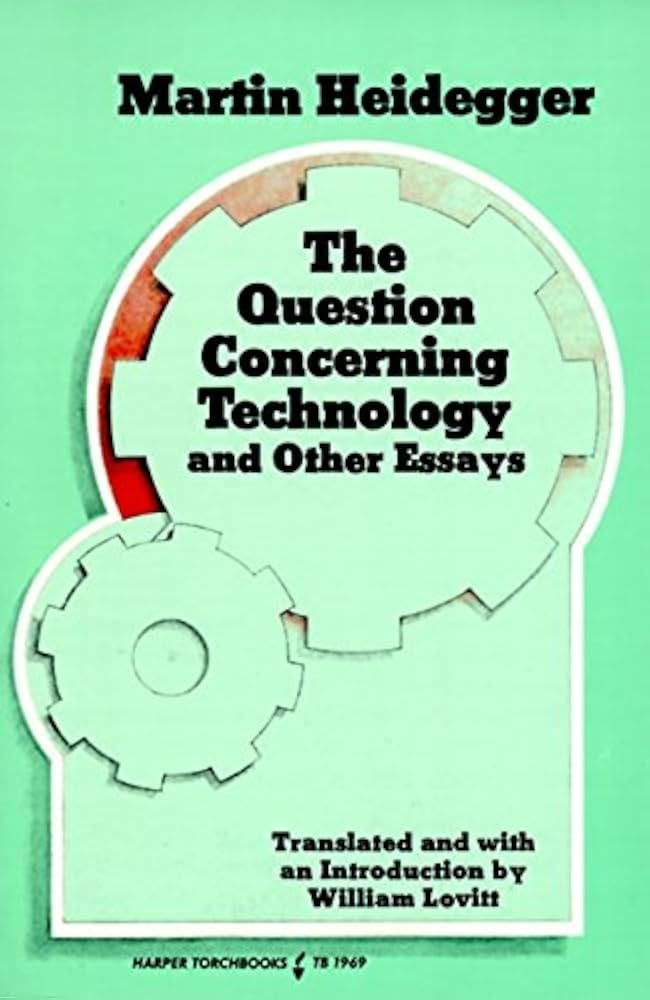
Even the essay that people are often tempted to reach for when bringing “Heidegger” and “technology” together, namely, “The Question Concerning Technology,” forces us from the start to consider whether instrumentality as such is really as clear to us as it seems as first glance. An instrument is just a means to an end, right? And therefore technology is a means, and a human thing, because a means to human ends, a means meant to be helpful to humans.
That is certainly possible. But Heidegger, because he thinks, leads us to see that in some sense both the means and the ends are a cause, or have been understood as causes in the history of philosophy — remember Aristotle’s four causes, where the final cause tells us something about “end,” while the efficient cause tells us something about “means” —maybe what it means to be a means or an end is not self-evident without reflection on what it is to be a cause? By the time Heidegger is done pulling that thread, we hear it said of the essence of technology that it is nothing technological, and that it puts us before both a danger and a saving power, something having to do with destiny, with the destiny of being as a mode of revealing. How far we shall have travelled from the anthropological and instrumental view of technology if only we have the patience to let Heidegger guide our thoughts for a while!
So does AI, the first self-interpreting technology, the first technology with a naming power, also have something to do with all of that, with destiny and salvation, with revelation, and not only with danger? And is this only reducible to “professions of faith” or amenable to genuine philosophical analysis? We will know better when we experiment further with rigorous, though flexible, application of themes from “continental” and mystical philosophy to AI.
It is inevitable, and happening; “in secret” and in the open.
also:
millermanschool.com
millermanintelligence.com
millermanlibrary.com
I share the sense that “just a tool” doesn’t capture whatever this is — the hammer comparison kinda breaks down. But I’m stuck at “self-interpreting.” For Heidegger, interpretation isn’t a property of outputs like LLM responses are but is something grounded in care. Dasein interprets because its own being is at issue for it… The question isn’t whether AI produces things that look like interpretations (it clearly does), but whether anything is at stake for it in producing them. Basically, can we even call it an interpretation?
Merleau-Ponty gives me a second way to say it. He distinguishes speaking speech — expression arising from the body’s grip on a situation — from spoken speech, the sedimented language already instituted. A language model is totally based in the sediment: a million past acts of expression, recombined, without an act of expression occurring. Which is not necessarily a “lesser” interpretation but something we maybe don’t have a name for yet, like an “averaging” interpretation or something.
Which might be the more interesting question your piece brings me to… not whether AI interprets, but what happens to language when it becomes standing-reserve? Gestell / enframing
Appreciate the piece and the thinking it provoked!
Your argument assumes that machine can understand, as opposed to having the ability merely to mimic the appearance of understanding. John Searle's "Chinese Box" thought experiment shows why they are not the same.