
The Multipolar Delusion?
Two essays, published on the same day, arrive at opposite conclusions about the world we live in. Only one of them can be right. Unless they both are.

On February 19, 2026, two very different thinkers published two very different essays about the same question: Is the world becoming multipolar?
C. Raja Mohan, writing in *Foreign Affairs*, says no. His essay, “The Multipolar Delusion,” argues that multipolarity is a fantasy. The world is still unipolar. Only the United States possesses the comprehensive capabilities (military, economic, technological, cultural, institutional) to function as a genuine pole in the international system. China is a “near peer” but falls short on global power projection, financial reach, and alliance networks. Russia has nuclear weapons and little else. BRICS is more aspiration than architecture. The “multipolar consensus” emerging from Washington to Beijing to New Delhi is, Mohan argues, a collective mirage, and a dangerous one, because it has emboldened the U.S. to shed the responsibilities that once accompanied its dominance. What we’re left with isn’t multipolarity. It’s unilateralism.
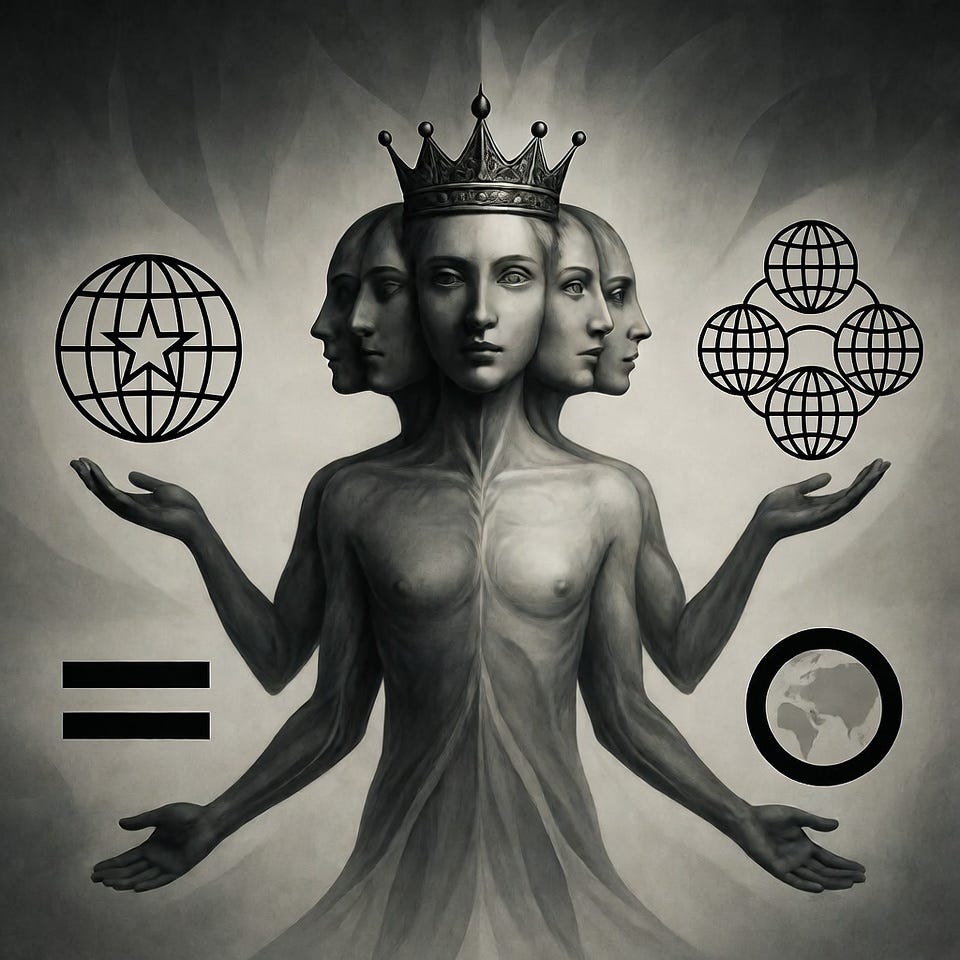
Alexander Dugin, writing on his Substack the very same day, says the opposite. In “The 5 Poles of the Trumped West,” Dugin argues that the collective West itself, once the unified core of the so-called unipolar world, is already fragmenting into five distinct geopolitical entities. Trump’s sledgehammer approach to international relations has shattered the Euro-Atlantic consensus. NATO’s coherence is in question. The UN is sidelined. Trump has declared that international law doesn’t apply to him. The result, Dugin argues, isn’t continued unipolarity but the accelerating disintegration of the very bloc that made unipolarity possible.
The Interesting Part
What makes this juxtaposition extraordinary is not that two people disagree: that happens every day. It’s that they’re looking at the same evidence and reaching opposite conclusions, and both arguments are internally coherent.
Mohan looks at material capabilities - GDP, military spending, tech dominance, alliance networks - and concludes that no one can challenge American power. He’s right, on his terms. No single state or bloc can match what the United States brings to the table across every relevant dimension of power.
Dugin looks at political coherence - the will to act as a unified bloc, shared ideological commitments, institutional solidarity - and concludes that the West is already fractured beyond repair. He’s also right, on his terms. The collective West that underwrote the “liberal international order” is indeed coming apart.
The question is: which dimension matters more? Material capability or political will? Hardware or software?
What Neither Author Will Say
Mohan, writing for Foreign Affairs, cannot take Dugin seriously. His essay never mentions him; nor would it. In the world of mainstream international relations scholarship, Dugin is persona non grata: sanctioned, controversial, dismissed as a propagandist or crank.
Dugin, writing from Moscow, has no interest in engaging the kind of quantitative capability analysis that Mohan offers. For Dugin, measuring GDP and counting aircraft carriers misses the point. Power is civilizational, spiritual, existential, not a spreadsheet.
This is why the two essays, published on the same day, never actually meet. They operate in separate intellectual universes. Neither author would acknowledge the other as a legitimate interlocutor.
But someone has to read them side by side. Someone has to take both arguments seriously on their own terms and ask what each one sees that the other cannot.
The Deeper Question
Behind the policy debate lies an older and more fundamental question. What is a “pole” in the first place? Is it defined by material power (Mohan’s implicit framework), or by civilizational identity and the will to constitute a distinct political order (Dugin’s explicit framework)?
This is, at bottom, a question about what makes a regime. Not regime in the journalistic sense of “government,” but in the classical sense of the way of life, the ordering principle, the thing that makes a political community this community and not some other one.
If a pole is defined by capability, then perhaps Mohan is right: there is only one. If a pole is defined by civilizational will, then Dugin may be right: even the West itself is splitting into several.
And if neither definition alone is sufficient, if a pole requires both material capability and civilizational coherence, then the truly disturbing possibility is that there are currently zero poles. That the world is not unipolar or multipolar but apolar: a system with enormous concentrations of power but no coherent political will directing any of them.
That would be genuinely new. And genuinely dangerous.
---
I teach a course on Dugin’s political philosophy, including his theory of the multipolar world, at Millerman School. If you want to understand these arguments from the inside, not just from headlines, that’s the place to start.
Everything is in flux right now because we are in a 4th turning. Not just that, we are in winter according to the Spengler cycle which makes things particularly dangerous.
The 4th turning most likely hasn't climaxed, and won't be over until around 2030. After that we can think about how many poles there are, it will most likely be very clear by then. And perhaps modernity will end this cycle and we are heading to a new age. Douglas Murray suggested the name "Age of Reconstruction", but I guess it's too early to call it.
Hope you will do content on Spengler, his prophecies seem to be pretty spot on so far. Which is frightening.
I do not know the other text. I read Dugins Text and I agree in general. I think that split is real. Trump turns america not isolationist but more egoist. The EU goes crazy and desparate in their "look at us, we are still relevant" phase and israel in a certain sense becomes a more and more aggressive (not only in the sense of violence which israel also does, but also in the field of asserting ones will) pole which basically says "we are willing and capable to supplant and succeed dying parts of the western alliance". Especially the EU which seems to by dying anyway, and which turns more and more into a laughing stock. And maybe, Israel even prepares for cases like a new US civil war and a split up of the US. Israel were always geopolitical egoists who basically lived a dual identity of "we are part of the west and defend the west against barbarism" on the one hand, and "we are a totally unique civilisation unlike the other parts of the west and we have a right to assert and defend our own civilisational values".
I think this also drives a certain conflict between the EU (and Soros Networks) on the one hand and Israel on the other. Many parts of the EU think israel needs to be educated into following western standards and scolded if they break these standards. Israel on this other hand hates these lectures from EU personell. I also think Israel thinks of the EU basically as an extension of germany and for obvious historical reasons, they do not want to be morally lectured by a geopolitical alliance dominated by germany. And this is VERY understandable.
The other thing is, I have the impression that many political zionists consider thhemselves to be a kind of moral vanguard of the west and that they feel that europe basically got to a higher level of civilisation due to jewish influence and christianity. I think the overemphasis of the term "Judeo Christian Values" is also a bit of flattery towards them, despite historic inaccuracies. (For example, Europe has a history of mistreating the jews. This fact contradicts the idea that the jews were leading in determining europes moral values.)
I think because of that, there were always tensions between Israel and Europe. But I think 2008, the Ukraine tensions and the refugee crisis of europe basically accelerated the break between Israel and the EU.
On topic of the US and the EU: I think the EU might have had the potential to become a competitor to the US in the end of the 90s but they made tons of mistakes (like for example not enough alignment with russia. Maybe the stopping of the german Transrapid Rail Project (a maglev train with a few similarities to Elon Musks Hyperloop which was pushed by germany around the time of the world fair 2000 and then abandoned due to pressure by the green party) might have been another failure of EU geopolitics. ) And already since George Bush jr. , the US prepared to drive a wedge between EU member states and basically split the visegrad group from western europe, because Visegrad is far more supportive of the US than western europe.
Gerhard Schroeder used the opposition towards the war in Iraq to switch to an eurasia strategy (the leaked Stratfor dossiers at the beginning of the 2010s stated that the US definitely feared that) but the US and Obama basically used Merkel to force a slow realignment. And Obama was basically used as a kind of Media campaign to spread Pro American sentiment again, but the EU is very soros aligned (the media as well) and they pushed the narrative of Trump being "the great Satan".) This basically accelerated the breach between both poles again. But now under woke ideas. And after Brexit and multiple repeated almost successes of Le Pens Ressembelemt National, the EU has a huge legitimacy crisis which makes them act more and more crisis. (I think this legitimacy crisis is also one reason for the Ukraine support. As the Ukrainian elites are by far the most pro EU elites in the whole block.)